
If you tune in, it probably sounds deeply familiar—maybe carrying the tone or attitude of your mom, your dad, or someone who held authority over you when you were young.
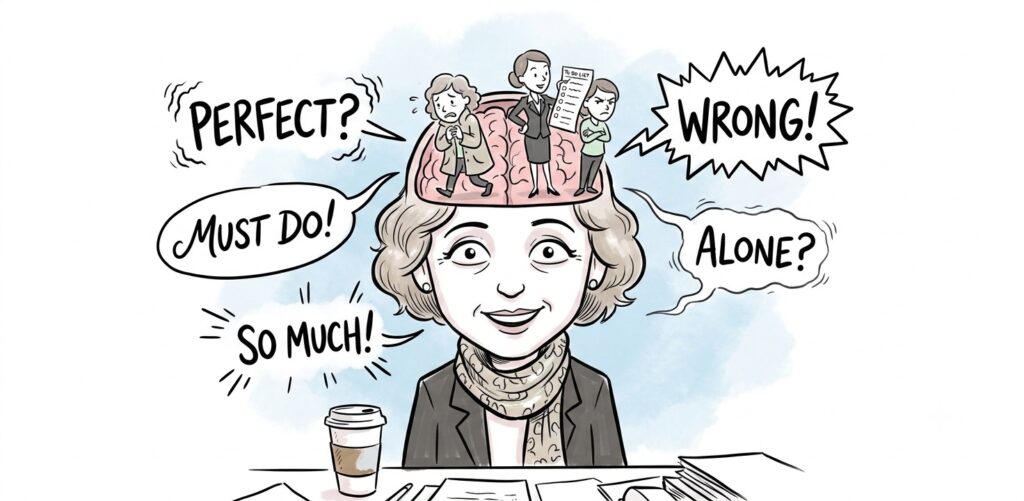
For example, it’s almost constantly narrating your life. It tells you how unprepared you were, how poorly you handled a situation, or that you shouldn’t be feeling what you’re feeling. Furthermore, no matter what you achieve, it is never enough. You accomplish something great, and yet within seconds, it moves the goalposts and tells you why you still failed or that it was pure luck.
Consequently, most of us live our whole lives assuming this voice is the absolute truth—like the voice of God in our heads. However, what if that voice is almost 100% inaccurate? It’s mean, it’s harsh, and moreover, it has been bullying your experience for years. What the hell is this voice, and therefore, how do you not identify with it? For it has to be clear—if there is a voice speaking, the question comes: to whom is it speaking?
Here is how we begin to loosen its grip, step by step:
1. The voice in your head: Who is listening?
Stop for just a second and notice this: If there is a voice in your head talking… who is the one listening to it? In fact, there is the voice (the commentator), and then there is you—the quiet awareness hearing it. Thus, if you can hear the voice, you cannot be the voice. Ultimately, that tiny realization is your first step to freedom.
2. The voice in your head: Catch it like a cat at a mouse hole
Because you can’t step away from a habit until you catch it in action, you must observe it closely. So, be like a cat waiting outside a mouse hole—completely relaxed, but intensely watchful. The next time you do something completely ordinary, such as opening the fridge, pay attention. Notice the voice jumping in: “You shouldn’t eat that,” “That’s bad for you.”Instead of trying to stop it or argue with it, just catch it. The moment you notice the script running, you step out of autopilot. That is the first step. Meanwhile, the second step is—rebel, object, speak.
3. Stop being quiet
Imagine a politician you completely distrust. When they stand on stage and tell lie after lie, do you sit there nodding and believing every word? Of course not. Instead, you object and question them. So why do you stay silent when the voice in your head lies to you about your worth?
First, say to it firmly: “Stop that.” Then, ask it directly: “Who are you? Who is speaking, and who are you speaking to?”When you ask that, the voice often pauses. Indeed, notice that quiet gap, and just rest there for a moment. Repeat that many times until the gap eventually becomes larger.
4. Reclaim your throne
Naturally, the voice will try to scare you. It will say, “If you stop listening to me, your life will fall apart.” In reality, it’s total nonsense. That voice doesn’t run your life—it just shows up after the fact to judge everything you do. In contrast, your actual, living experience—your presence, your warmth, your joy—is the true authority here. Therefore, you don’t have to fight the voice or force it to disappear completely. As you stop believing its lies, it naturally loses its power. As a result, it gets softer, nicer, and gentler.
After all, reclaiming your peace from a voice that has governed your experience for decades takes a little curiosity, determination, and a bit of inner rebellion. And above all, you have it all.
So much love to You,
Luchana
